FRESCO4NoPain work packages and research projects
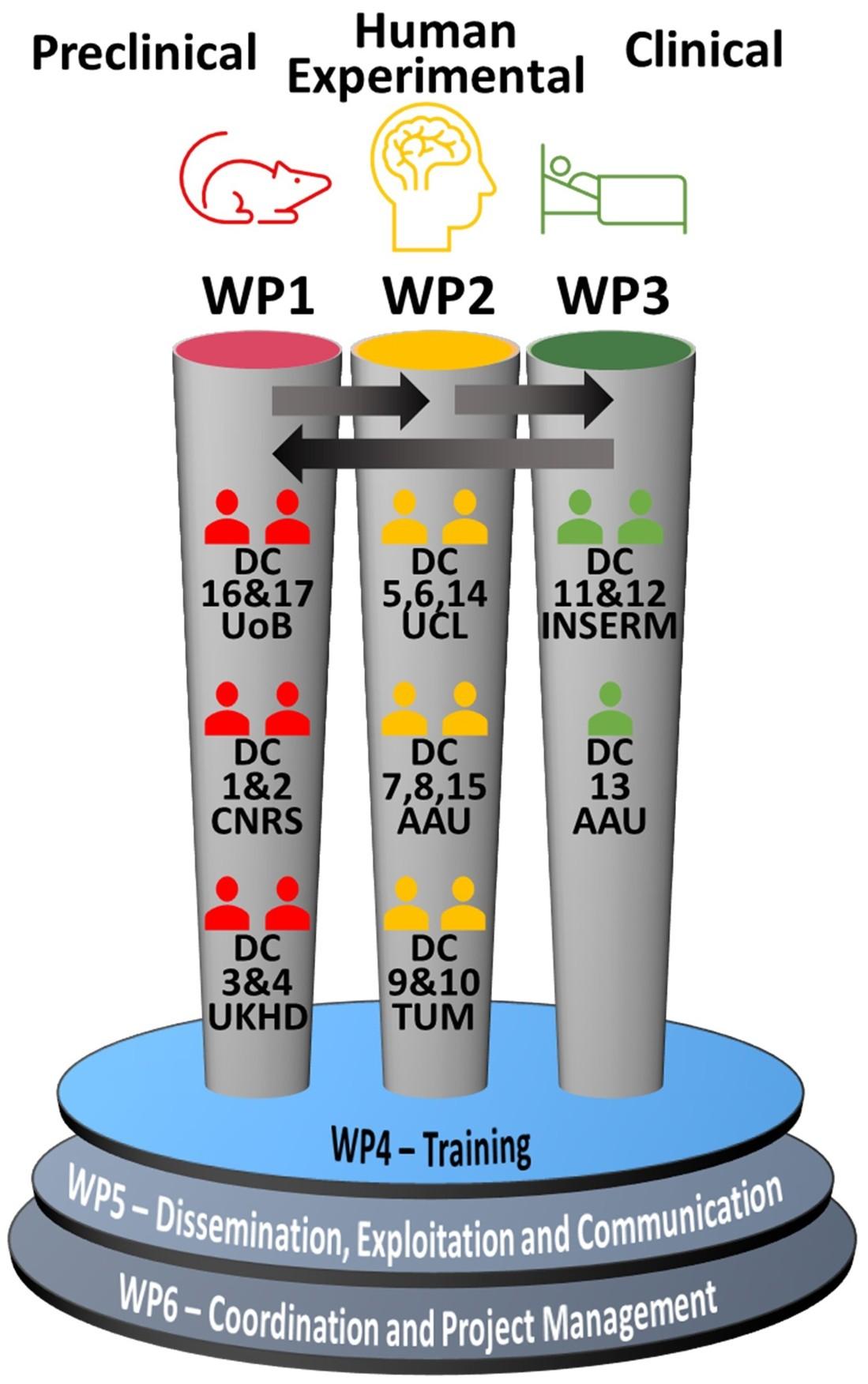
The 6 FRESCO4NoPain work packages.
Work package 1: Preclinical research
This work package investigates how pain alters brain function in rodent models and explores ways to restore healthy brain oscillation activity. By pinpointing the key regions and networks involved in pain processing, doctoral candidates in this work package aims to uncover new possibilities for improving pain management.
Lead academic partner: University of Bristol (UoB).
Work package 2: Experimental research
This work package investigates how pain alters brain oscillatory activity in humans and how targeted stimulation of the brain or spinal cord may help reduce it. Using innovative methods, it examines how different types of stimulation influence brain rhythms and connectivity, and how these changes relate to pain perception. This work package also explores how short‑term and long‑lasting pain affect brain activity, helping to guide the development of more effective, non‑invasive pain relief strategies.
Lead academic partner: UCLouvain (UCL).
Work package 3: Clinical research
This work package investigates how patterns of brain oscillatory activity relate to symptoms in people with chronic pain conditions that do not respond to standard treatments. The goal is to identify markers that can predict who may benefit from specific therapies and to explore ways to enhance the effectiveness of existing treatments.
Lead academic partner: Center for Neuroplasticity and Pain (CNAP).
Work package 4: Training
This work package supports the professional development of the doctoral candidates by creating tailored career development plans, offering a high‑quality and diverse training program, and providing continuous mentoring throughout the FRESCO4NoPain Project. It also helps integrate the doctoral candidates into relevant academic and industry environments, ensuring strong support both locally and across the wider network.
Lead academic partner: UCLouvain (UCL).
Work package 5: Dissemination, communication and exploitation
This WP aims to ensure that the FRESCO4NoPain project results are adequately disseminated, exploited, and communicated broadly, maximizing the impact and outreach of ensuing scientific advancements to all stakeholders.
Lead academic partner: National Centre for Scientific Research (CNRS).
Work package 6: Project management
This work package ensures smooth coordination and management of all FRESCO4NoPain. It oversees progress tracking, partner communication, interactions with the EU project officer, and the organization of network‑wide events. It also manages inclusive recruitment, reporting, documentation, risk and data management, and overall quality assurance.
Lead academic partner: Center for Neuroplasticity and Pain (CNAP).